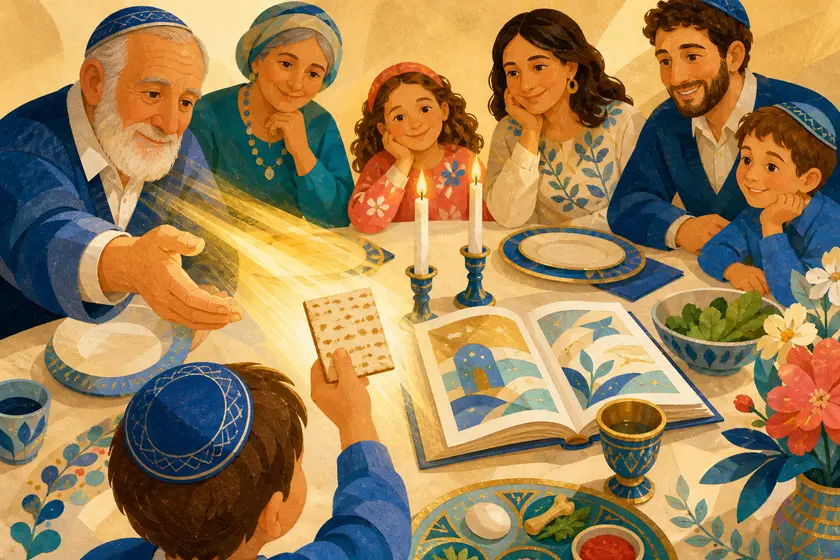
A child can hold the holiday in one piece of matzah
Passover carries the Exodus from slavery to freedom through questions, symbolic foods, family stories and songs. The lyric begins with concrete images children can touch and remember: matzah in a hand, listening candles, rising stories and shared light.
The source here is the living practice of the Seder, not an inherited melody. Walter J. Kin wrote the English words and music as a new Jewish song.
Creative starting pointPassover memory translated into a short original English song
A new song can make inherited meaning physically memorable without simplifying it into a slogan.
The same composition received a warmer family arrangement
Passover Light is an alternative version of Walter's song Pesach. It uses a warmer klezmer and folk arrangement and one lyrical variation: Laughter brightens up your eyes replaces Pesach brightens up your eyes.
Walter wrote the music and lyrics and created the arrangement and production. Riglis Band performed the released recording.
What changedArrangement and one lyric line changed while the composition remained connected
A new Jewish song can have multiple arrangements for different listening and participation settings.
The release invites singing, questions and intergenerational use
The finished version is designed for homes, classrooms, Seders, schools, camps and community programs. Its public educator material asks children what freedom means and how one generation passes a story to the next.
This is a released creative example, not a claim of broad adoption. Its value is that a major Jewish holiday now has another concise English song available for people to hear, teach and sing.
Current outcomeA released original English Passover song with educator support
Creating the repertoire is the first step. Communities decide which songs become tradition.